2025's Most Telling Campaigns
Happy holidays! As the year winds down, we’re looking forward to a well-deserved break and a chance to return in January recharged, refreshed and inspired.
Before signing off, we wanted to pause and reflect on some of the most telling marketing moments of 2025. This was a year of bold swings and cultural moments, with brands pushing the boundaries of creativity, technology and trust.
For our final issue of the year, we’re breaking down a few campaigns that felt especially revealing. Each one made a clear choice, and together, they point to where marketing is headed next.
🧊 The Ordinary | "The Periodic Fable": Blowing Up The Beauty Industry's BS
The Ordinary swapped the periodic table's elements for 49 beauty marketing terms, then created a digital experience explaining what each term actually means (or doesn't).
The campaign led with a surreal short video set in a futuristic classroom. Students dressed in white chant beauty buzzwords — "magic," "fat freezing," "medical grade" — while performing literal versions of these pseudo-scientific claims, like rubbing ice on their faces. The video ends with a strong message: "We've been taught beauty wrong."
While competitors stack their packaging with meaningless buzzwords to command attention and premium prices, The Ordinary called out the entire industry and made sure consumers knew where to find the truth.
Takeaway: In a world of influencer oversaturation and market distrust, consumers are tired of being lied to and desperate for honest direction. Expose the BS, call out the old way and use transparency as a weapon to turn skepticism into an advantage.
🦉 Duolingo | "Duo Dies": Killing Your Mascot to Drive App Usage
Earlier this year, Duolingo announced that Duo, their notoriously pushy owl mascot, was killed in a Tesla Cybertruck accident.
The internet erupted. Brands mourned. Mentions of Duo on social media spiked by over 25,000%. Even Dua Lipa (Duo’s longtime crush) posted and commented about it.
Then came the resurrection mechanic: users could complete lessons on the app to “bring Duo back." One week later, Duo returned. Users had earned over 50 billion points on the app. In the reveal video, Duo admitted his death was staged to get people to do their lessons and make Dua Lipa notice him.
The campaign was certainly productive. Duo’s death generated 120+ million TikTok views and millions of completed lessons. Duolingo’s most effective engagement mechanic in 2025 wasn't a discount or giveaway — it was making their audience the hero. The Tesla Cybertruck wasn't random either. It was cultural commentary baked into virality. Every element served multiple purposes: entertainment, engagement and subtle satire.
Takeaway: Crowded feeds and AI copywriting have made everything look the same. Make your marketing stand out through bold storytelling, community participation or creative narratives. Not every post needs drama, but every brand needs a voice.
🎨 Canva | "Creative Chaos": Billboard That You Want to Share on Slack
At London's Waterloo Station, Canva installed oversized billboards featuring phrases like "make the logo bigger" and "turns out the 16×9 was actually supposed to be 9×16." One showed Canva's logo floating outside the frame entirely with the message "When 'make the logo bigger' goes a bit too far." The visuals extended beyond edges in a clever case of form meeting function that brought design-by-committee chaos to life.
Canva didn't try to position itself as the solution to client-agency dysfunction (because everyone knows there isn't one). Instead, they made the joke we're all thinking. Every designer, creative director and agency professional has gotten the "make it pop" Slack message at 5pm on a Friday. Canva put those frustrations on a billboard and said: we see you, we feel you, we are you.
Takeaway: B2B buyers don't want another "solutions" page promising to “streamline your workflow.” They want brands and products that actually understand their reality. Acknowledge the dysfunction, laugh at the chaos and build solidarity.
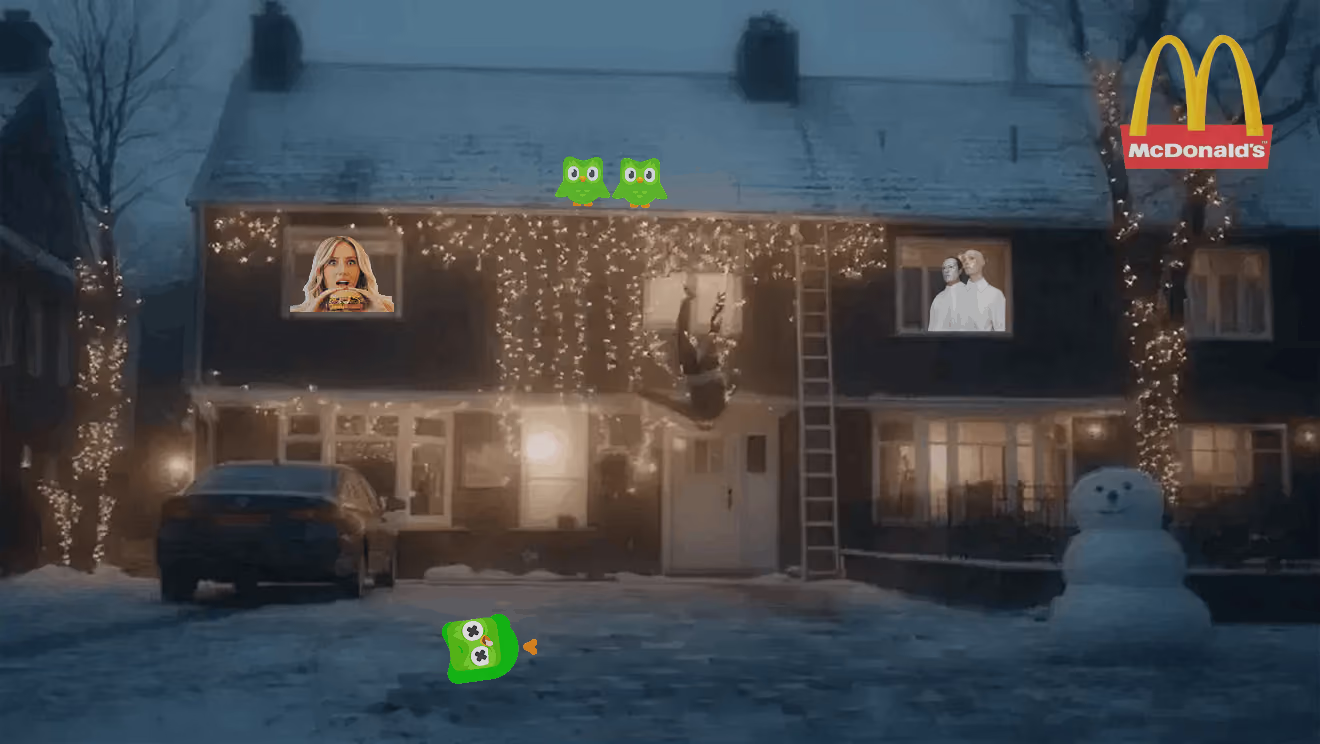
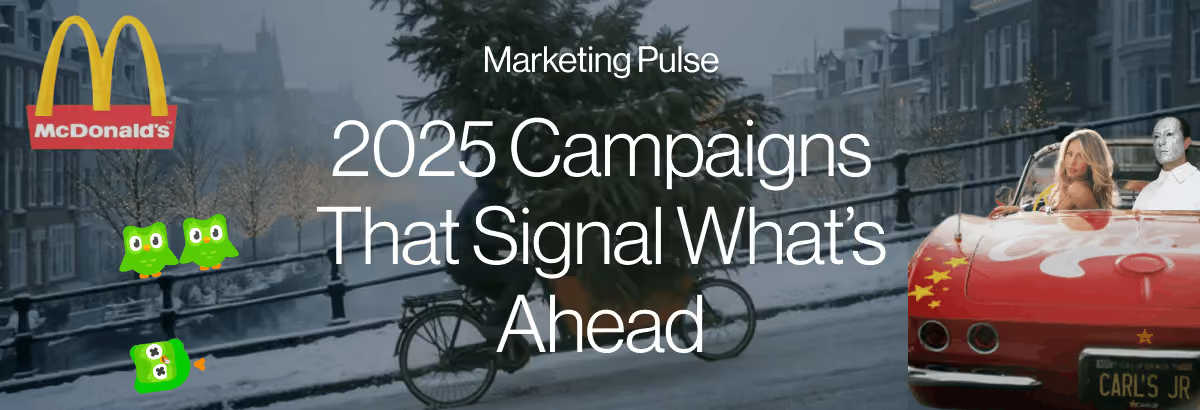
🎄 McDonald's | "The Most Terrible Time of the Year": AI Can't Fake Emotion
McDonald’s released an AI-generated Christmas ad packed with holiday mishaps set to a reworked version of “It’s the Most Wonderful (Terrible) Time of the Year.” The message was blunt: the holidays are chaotic, so escape them by hiding out at McDonald’s.
Instead of offering comfort within the chaos, the ad positioned the season itself as something to avoid, using AI visuals that felt emotionally hollow. The response was swift and brutal: comments were disabled, the ad was pulled entirely and McDonald’s acknowledged its misstep.
The failure wasn’t rejecting holiday spirit or the idea of “too much family time” — it was treating a deeply emotional moment as something to escape rather than soften. At a time when audiences are especially sensitive to authenticity and storytelling, the message landed as tone-deaf, not funny.
Brands can acknowledge chaos, but do it empathetically. Canva managed that balance by leaning cynical, but grounding its humor in humanity and relatability. McDonald’s learned what many brands discovered in 2025: when AI is used to replace human emotion, especially for a brand built on comfort and tradition, it completely misses the mark.
Takeaway: The AI honeymoon is over. Speed means nothing if the output is hollow, especially in high-emotion, high-expectation moments. Audiences notice, and respond accordingly.
🍔 Alix Earle x Carl's Jr. | How Controversial Can Authenticity Be?
Carl's Jr. partnered with Alix Earle to bring back its infamous early-2000s aesthetic. The "Kay So?" spot featured Earle at a nightclub where everything (shot glasses, tops, lip gloss) is made of queso. She heads to the drive-thru, takes a bite of the new Queso Crunch Burger, and Paris Hilton pulls up in a Bentley to update the tagline: "Kay, so that's hot."
Of course, the campaign sparked debate. In an age where body standards and food messaging are under heavier scrutiny than they were 20 years ago, some viewers found the pairing of a thin Alix Earle with a greasy, queso-doused burger contradictory. At the same time, Earle’s personal brand has long included late-night partying and unapologetic drunk, late-night junk food orders, making the behavior itself feel familiar (and for some, relatable). The tension is exactly what fueled conversation, and it underscores a larger truth: the campaign didn’t sanitize Carl’s Jr.’s legacy or Alix’s persona. It leaned into both, and let culture react.
Takeaway: If the first four campaigns didn't make it clear, authenticity trumps everything: perfection, AI efficiency, lofty promises, polished copy. Lean into what's real, even if it's controversial. Your core audience will reward you for it, and that's what builds lasting brands.

📄 7 Social Media Trends You Need to Know in 2026 (SproutSocial): A timely look at how social behavior is shifting heading into 2026. Sprout Social explores declining tolerance for brand noise, rising expectations for authenticity and why fewer, higher quality posts are driving stronger engagement than always-on content calendars.
📄 The Future of Social Looks Like Intimacy at Scale (Link in Bio): An interview with Lara Adekola, Glossier Senior Social Media and Community Manager, on the brand’s steady success on social media and the shifts we’ll see as the industry evolves.
📄 The Biggest Takeaways from Pinterest Predicts 2026 (Tapped In): A breakdown of Pinterest’s annual “not-yet-trending” report based on user search behavior and the signals marketers need to pay attention to in 2026.
Final Thoughts
If there's a theme across marketing from 2025, it's this: marketing works when it tells the truth.
The brands that broke through didn't chase polish and perfection — they leaned into authenticity to build community, drive awareness and strengthen positioning. In a landscape where change is the only constant, audiences continue to reward brands that understand context, emotion and culture. AI will accelerate production, creators will shape narratives and attention will remain expensive. But the differentiator won't be tools or tactics. It will be judgment: knowing when to push, when to soften, when to joke and when to make people feel seen instead of sold to.
We kept these lessons in mind as we reflected on our own work this year. 2025 was a big year for Breef: a brand refresh that helped us show up more authentically, a growing community of brands and agencies and a clearer vision for what’s next. The lessons, wins and challenges that brought us here will continue to guide how we support our community in the year ahead.
Thank you for being part of what we’re building at Breef. Happy holidays, and here’s to what we’ll create together in 2026!
That wraps this issue of the debreef. Keep an eye on your inbox for the next edition. In the meantime, browse more on our blog: The Breefing Room