What Is a Boutique Agency?


Marketing rarely fits into one job description, but building every capability in-house isn’t always practical. A boutique agency is typically a smaller firm with a focused team and a more hands-on way of working. Some specialize in one discipline or industry, while others offer several connected services. Boutique describes the agency’s structure, not a fixed service list.
For brands, that can mean focused expertise, closer collaboration and more flexibility. It can also mean less capacity when a project spans many markets, disciplines or simultaneous workstreams.
Breef works with a community of 25K+ vetted agencies, including boutique teams, so this guide has no preferred model. For the broader selection process, start with how to choose a marketing agency.
What Is a Boutique Agency?
A boutique agency is a smaller agency with a focused team and a hands-on way of working. In marketing, a boutique marketing agency may specialize in a discipline, industry or project type, but it does not have to be narrowly specialized. Some boutique agencies offer several connected services.
There is no universal headcount that makes an agency boutique. Size is one signal, but team structure, client load, senior involvement and how much work stays in-house reveal more about how the agency operates.
Smaller teams can bring the people doing the work closer to the client relationship. Brands may work directly with strategists, creatives or agency leaders instead of routing decisions through several account layers. That access is not automatic, so confirm who will attend meetings and handle the day-to-day work.
Boutique teams are often founded by former in-house marketing directors, creative leads or strategists who leave larger organizations to build an agency with a partner or small team. They may build depth across a few disciplines or industries rather than trying to cover every category.
This model can work well when a brand knows what expertise it needs, values direct collaboration and wants a closer working relationship.
Boutique in Marketing vs Other Industries
“Boutique” is not a marketing-only term. In literary and acting industries, it may describe a smaller representation firm. In marketing, it describes an agency’s team structure and working style, not the type of talent it represents.
Boutique vs Large vs Full-Service Agencies
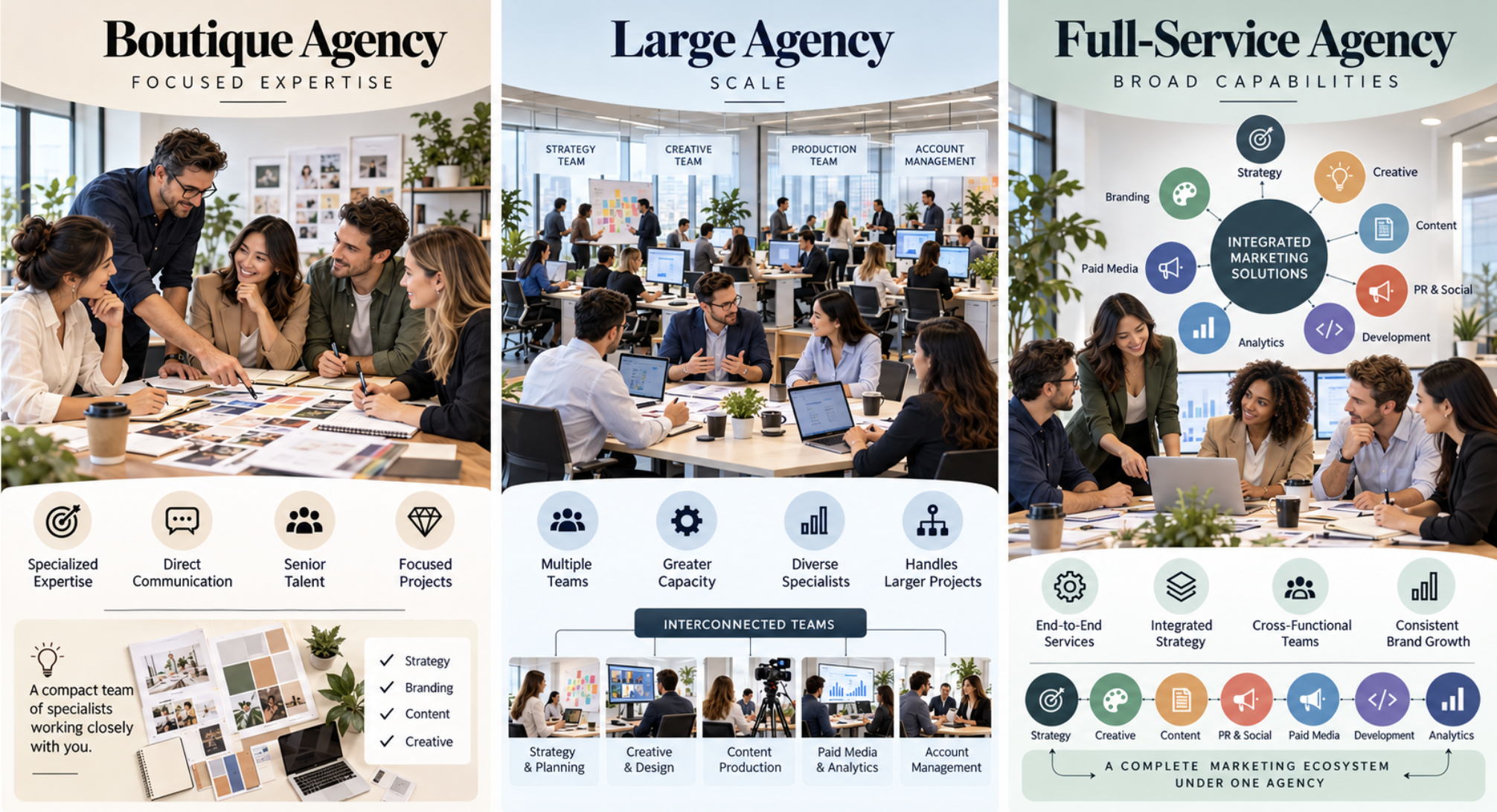
These labels describe different things. The terms boutique and large usually describe agency size and operating model, while full-service describes service breadth. A boutique agency can be full-service, and a large agency can still specialize.
The pitch is a preview, not a staffing guarantee. Ask who will lead the strategy, who will handle the day-to-day work, how many accounts each person supports and whether the proposed team will remain involved after selection.
Also ask what stays in-house. Large and full-service agencies may use external partners or white-label providers that deliver work under the agency’s name. Boutique agencies can subcontract too. Outsourcing is not automatically a drawback; the issue is whether ownership, quality control and accountability are clear.
Choose the model around the work. A boutique or specialist agency can make sense when you need focused expertise and direct collaboration. A large or full-service agency may be more practical when several disciplines, markets or workstreams need to move at once.
For a closer comparison of service breadth, see full-service vs specialized agencies. You can also review types of marketing agencies to understand where each model fits.
The Benefits of Working With a Boutique Agency
The benefits of a boutique agency often come from its operating model: a smaller team, fewer organizational layers and closer access to the people doing the work. Those advantages still depend on the agency’s client load, capacity and fit with your project.
Scalable Budgets
A boutique agency can shape an engagement around a defined priority, giving your team more control over where the budget goes. Instead of building a broader engagement around multiple services, your team can scope the work around the capabilities the project actually needs.
That does not make boutique agencies automatically cheaper. The value comes from matching the scope and team to the priority without paying for capabilities the project does not require.
Flexible timelines
Fewer organizational layers can make it easier to adjust the scope, sequence or workflow when priorities shift. That flexibility can help with project-based work, launches, campaigns or brands that are still determining how much external support they need.
Flexibility still depends on capacity. A small team with a full client roster may have less room to pivot, so confirm timelines, availability and approval requirements before work begins.
Prioritized Support
A boutique structure can create closer access to senior strategists, creatives and agency leaders. When those people remain involved after the pitch, communication can be more direct and decisions can move through fewer layers.
A smaller team does not guarantee more attention. Ask how many clients each team member supports, who will manage the day-to-day relationship and how quickly the agency can respond when priorities change.
Specialist Expertise
Many boutique agencies build depth around a few disciplines, industries or project types. Repeated experience with similar challenges can help the team identify patterns, ask more specific questions and bring a sharper point of view to the work.
That focused expertise can support a defined need without requiring a brand to build the same capability in-house. Confirm that the agency’s experience matches your project rather than relying on the boutique label alone.
Collaboration With Internal Teams and Other Agencies
Boutique agencies can complement an internal team or work alongside other partners. A brand may bring in a boutique agency for one capability while keeping strategy in-house or assigning other channels to separate agencies.
When several partners are involved, define who owns the strategy, handoffs, approvals and shared measurement. For more on creating that structure, see managing multiple agencies.
When a Boutique Agency Isn’t the Right Answer
A boutique agency isn’t always the right fit. A larger or full-service agency may offer more capacity when a brand needs to coordinate work across several markets, manage many product lines or engage multiple specialties at once.
A global rollout, for example, may require regional teams and specialists working simultaneously. High-volume production across several product lines can also demand more resources than a smaller team can provide without delaying the work.
Some brands also need one accountable partner to connect strategy and execution across many marketing functions. In that case, the simplicity of a broader agency relationship may matter more than specialized expertise in any individual discipline.
Choose the model around the scope, pace and complexity of the work. A boutique agency can bring focused expertise and close collaboration, while a larger or full-service agency can provide the breadth, scale and coordination a complex project requires.
The decision doesn’t have to be permanent. A brand can use an internal team, a boutique agency, freelancers and other agencies at different stages of growth. To compare those options, explore agency vs freelancer vs in-house.
What Does a Boutique Agency Cost?
There is no single price for working with a boutique agency. Cost depends on the scope, specialists involved, timeline, pricing structure and level of support the brand needs.
A smaller agency is not necessarily a cheaper agency.
Boutique agencies may charge a project fee, monthly retainer or hourly rate depending on the work. Direct access to senior specialists can raise the fee. At the same time, a boutique engagement may be more efficient when a brand needs a specific capability rather than a large team covering many disciplines.
When comparing costs, look beyond the headline price. Ask what the fee includes, who will do the work, how involved senior specialists will be and whether the agency expects to use outside partners.
It is also useful to compare like with like. A boutique agency handling a focused project should not be compared with a full-service agency responsible for strategy, creative, media, development and other functions unless both proposals cover the same work.
The most important question is not simply whether a boutique agency costs less. It is whether the team, expertise, scope and deliverables justify the investment.
You also do not want to be the smallest client at an agency. Ask how your budget and scope compare with its typical engagement so you can judge whether the relationship is a practical fit.
Brands can join Breef, post a project and receive agency pitches for free. After successfully hiring an agency, the brand pays a one-time $199 placement fee. Agency fees remain separate.
Review what Breef costs for Breef Platform pricing and explore agency pricing models to compare retainers, project fees and hourly rates.
How to Find and Evaluate a Boutique Agency
Once you’ve decided a boutique model fits your needs, focus on how each agency operates rather than relying on the label alone.
Start by asking about the size of the team working on your account. Then find out how many clients each proposed team member supports and who will be directly responsible for your work.
Ask whether the people introduced during the sales process will remain involved after the engagement begins. It is also useful to understand which services are handled internally and which, if any, are provided through outside partners.
Review work that is relevant to your project. A portfolio can show whether an agency has addressed similar challenges, but the conversation should also cover how the team would approach your specific objectives.
Breef helps brands explore vetted agencies based on the work they need. You can browse 48 project types to clarify the support you need, then use questions to ask an agency to guide your evaluation.
Find the Right Boutique Agency With Breef

Choosing an agency starts with a clear understanding of what your project requires.
Breef’s network includes 25K+ vetted agencies, including boutique teams with focused expertise across different types of marketing work. Team Breef curates options around your project scope and goals, helping you compare pitches with confidence.
You can browse 48 project types to clarify the support you need, then start your project with Breef.
Frequently Asked Questions
What Counts as a Boutique Agency?
A boutique agency is generally a smaller agency with a focused team, fewer organizational layers and a hands-on working style. It may specialize in a discipline, industry or project type, but it can also offer several connected services. No universal headcount defines a boutique agency.
Are Boutique Agencies Cheaper?
Not necessarily. Boutique agencies can offer flexible engagement structures, but specialized expertise does not automatically cost less. Compare the scope, team, expertise and expected deliverables rather than choosing an agency based only on its size or headline price.
What Is the Difference Between a Boutique Agency and a Full-Service Agency?
Boutique usually describes an agency’s size and operating model, while full-service describes the breadth of its capabilities. A boutique agency can be full-service if it offers several connected disciplines. Compare each agency’s capabilities, team structure and capacity instead of treating the labels as opposites.
How Many Clients Does a Boutique Agency Take On?
There is no single client limit that defines a boutique agency. The more useful question is how many clients each team member supports and whether the agency can provide the level of attention your project requires.
Is a Boutique Agency Right for a Large Brand?
It can be. Large brands may use boutique agencies when they need specialized expertise or support for a particular initiative. However, a large or full-service agency may make more sense when the brand needs many disciplines, markets or teams coordinated simultaneously.
What Should I Ask a Boutique Agency Before Hiring One?
Ask who will handle the day-to-day work, how many clients each team member supports, what stays in-house, whether outside partners are involved and how the agency’s experience relates to your project.