Building your project scope
Inside MERIT Beauty's Discipline: The Brand Making Minimalism a Strategy

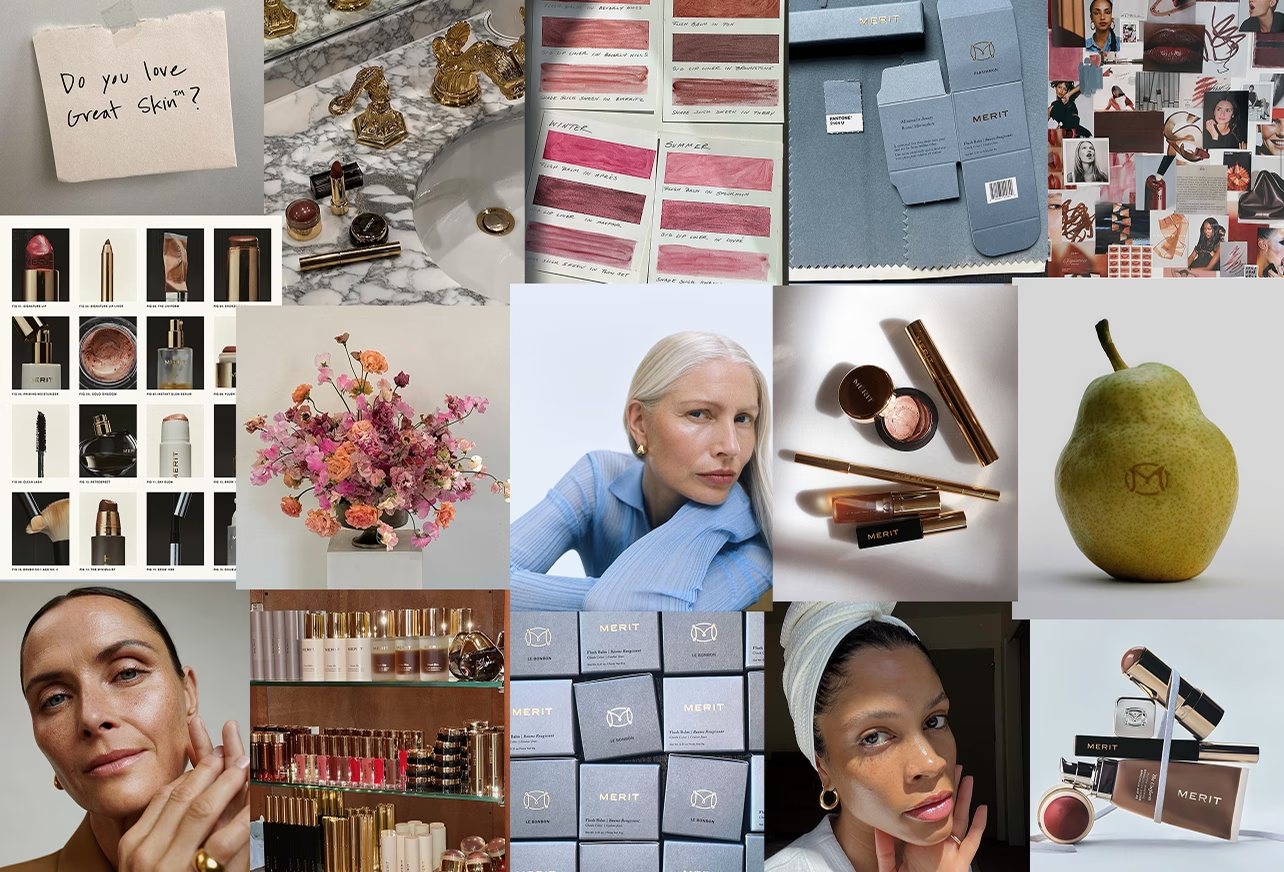
The beauty industry has a newness problem.
A new SKU every four to six weeks. A celebrity face every quarter. A TikTok trend cycle so fast that by the time a brand shoots a response, the moment has already moved on. The machine runs on volume, velocity and the constant implication that last season’s products are no longer enough.
MERIT Beauty launched in 2021, looked at all of that and said, no thank you.
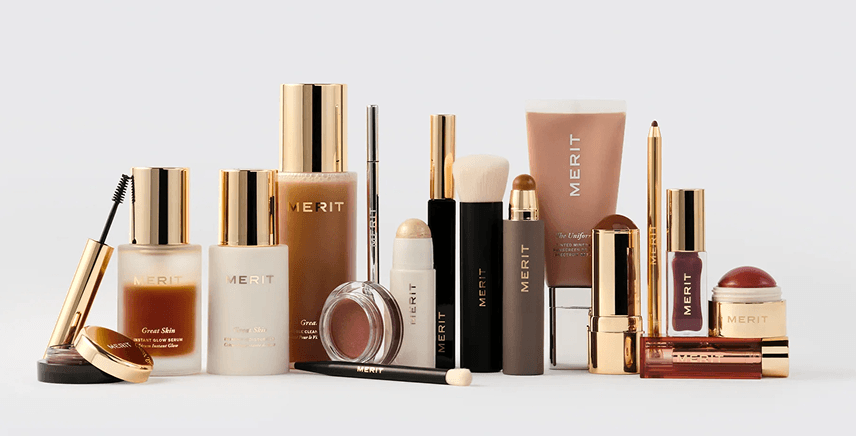
Seven products. No celebrity ambassador. A target customer the rest of the industry was actively ignoring. And a founding CMO who believed the marketing funnel (the one every brand was optimizing) was fundamentally broken.
Five years and $100 million in cumulative revenue later, MERIT has become one of the most closely studied brands in beauty.
The Gap Nobody Wanted
In 2021, the beauty market had two clear poles. On one end: Glossier, built for the millennial minimalist but skewing younger and younger. On the other: legacy luxury like Dior and La Mer - priced and coded for a consumer who wanted prestige theater with her morning routine. Neither was talking to the woman who just wanted to get out the door.
Katherine Power, MERIT’s founder and a serial brand-builder behind Who What Wear, Byrdie and Versed, saw the opening. In a Business of Fashion interview, she put it plainly: “I didn’t fit into the bronzed and contoured Kardashian look, and I was older and maybe a little more professional than a Glossier customer.”
So MERIT went after the gap nobody else was chasing (while taking a page out of Glossier’s book): clean, minimal, functional beauty for a woman who treats her makeup routine as utility, not a hobby. Founding CMO Aila Morin has been precise about this from the start.
The data bears it out. Roughly 50% of MERIT’s website visitors are between 25 and 45, with just as many over 55 as under 25. That kind of cross-generational pull is almost unheard of in a category that typically indexes hard into a single decade of life.
As Fortune noted in a 2024 profile of Power, MERIT typically features talent over 40 (including legendary Vogue editor Grace Coddington) that speaks to its core customer while remaining aspirational to younger ones. The brand isn't trying to rope in every demographic, it’s doubling down on the one it was built for.
Here’s the kicker: MERIT didn’t achieve that by broadening the target; it got there by refusing to chase anyone outside of it. No trend-coded campaigns to rope in Gen Z. No pivot to “everyone’s welcome” as the brand scaled. The audience grew because the positioning held. That kind of discipline (staying in your lane when growth pressure is telling you to drift) is rarer than it sounds.
The CMO Who Still Reviews Every Social Post
Most beauty brands talk about social media like it's a distribution channel. Post here, spend there, measure reach, optimize CPM. MERIT treats it like the actual ground floor of the brand which means the most senior marketing leader in the building is in the room when content gets made.
That's not a given. At most companies of MERIT's size and scale, the CMO is reviewing decks, not approving individual posts. Morin does both.
She came up in the early days of Instagram, ran MERIT's social accounts herself at launch and five years later, with the brand at $100M and growing, she still sits in every single social review. Her reasoning, shared in a February 2026 interview with Rachel Karten for Link in Bio: "I don't believe the delusion that social media is done by one manager. I think it's one of the most damaging things that executives believe about social media."
The output reflects it. Link in Bio readers nominated MERIT as the second-best brand account on social last year, behind only Duolingo which, for a beauty brand that almost never participates in TikTok trends, is a remarkable result.
That last part is important. MERIT's social discipline looks a lot like its product discipline: say no to most things so the things you do say yes to actually land. The brand's two biggest viral moments yet — the Solo Shadow thesis video and a get-ready-with-me with Kelly Rutherford (yes, Lily van der Woodsen from Gossip Girl) had zero paid media behind them.
No boosting, no seeding. They worked because they were honest, and because they fit the brand so specifically that nothing about them felt manufactured.
The deeper structural move, though, is the one most brands can't bring themselves to copy. MERIT builds campaigns before it builds products, not after. The creative thesis comes first., then the product gets developed to serve it. Which means by the time something launches, the story isn't being retrofitted around the formula, it’s already fully formed.
Most brand teams work in reverse (and you can feel it). Product emerges from the lab, gets handed to marketing three months before launch, and the team scrambles to build a narrative around something they had no hand in shaping. The result is content that feels disconnected (because it is). MERIT's sequence solves for that at the source.
.png)
Why Launching Less is Actually Harder Than it Looks
Here’s a question the beauty industry rarely asks: what if you launched less? Not as an aesthetic choice, but as a business strategy.
The norm is a new SKU every four to six weeks. It feeds the content machine, satisfies retailers who want novelty on shelves and keeps paid social campaigns refreshed. It also creates a kind of organizational ADD — every new launch pulls attention from the last one, and hero products never get the sustained marketing investment they’d need to become icons.
MERIT’s development process (by contrast) takes years rather than months.
“We move slowly and deliberately, from ideation through formulation, testing and execution,” Morin told TheIndustry.Beauty, “always asking whether a product truly earns its place in someone’s everyday routine.”
The payoff for that patience is a second-order advantage most brands don’t plan for: you get very good at marketing what you already have.
For MERIT’s fifth anniversary, when every investor and industry contact apparently asked what new product they were launching to celebrate, the answer was, nothing. They re-heroed a five-year-old foundation stick in a campaign called Minimalist.
“How do you take something five years old and tell a new story and make it relevant and make it move units?” Morin told Karten. “It keeps me up at night.”
The risk is worth naming honestly: discipline can harden into rigidity.
Minimalism is no longer a niche positioning, it’s becoming a category default. If MERIT’s evergreen thesis starts to feel like everyone else’s aesthetic, the brand will have to find ways to evolve the story without abandoning the slow-growth operating model that made it work. That’s not an easy needle to thread.
But most brands never even get to face that problem because they never had the discipline to create it.
No Meta Dependency, No Celebrity, No Panic
Ask most DTC beauty brands how they spend their ad budget, and the answer is some version of: mostly Meta, some TikTok, maybe a little influencer.
It’s the default stack, but it can also be a single point of failure. MERIT built around a rule from the beginning: never more than 30% of ad spend on any one platform.
“That strategy meant that we went offline in marketing very early,” Morin told Karten. “Things like billboards, direct mail, podcasts.”
The 80/20 framework sits underneath that: 80% of the budget goes to what’s proven to work, 20% to what Morin calls “crazy bets.” It’s a portfolio approach to media, not a single thesis.
And it’s paid off twice. Once when iOS privacy changes torched Meta ROAS across the industry, and again as TikTok’s regulatory uncertainty has brands quietly hedging.
The deeper reason for the offline investment, though, is simpler than risk management. MERIT’s core customer (the 30-to-50-year-old professional woman) is less online than the audiences most beauty brands are optimizing for. “There’s many that don’t have it at all because they made the decision that it’s not adding value,” Morin explained. So chasing her on TikTok makes no sense because she’s somewhere else. Billboards. Podcasts. Direct mail that actually arrives.
The industry instinct is to follow attention wherever it concentrates. MERIT’s instinct is to follow its customer. Those are different things, and the distinction matters more than most brands realize.
MERIT vs. The Industry: Two Very Different Bets
To understand what MERIT is doing, it helps to look at what most of the beauty industry is doing instead.
The dominant playbook is loud by design — lavish influencer trips, celebrity faces, controversy (sometimes) that converts. Campaigns engineered for cultural noise and built to spike (which they do, reliably) until the next brand does it louder. It's an attention economy in the most literal sense: you rent reach, generate a moment and hope enough of it sticks.
MERIT's model is the inversion. No trips or celebrity faces. For its fragrance launch, Morin told People Brands and Things: "We skipped the celebrity spokespeople and the expected ways of marketing, and instead focused on how it would make people feel."
The brand earns attention rather than buying it through storytelling that takes longer to build and doesn't spike as dramatically, but also doesn't require constant reinvestment to sustain.
Neither approach is wrong in some absolute sense. The loud playbook is optimizing for scale, velocity and cultural noise. MERIT is optimizing for retention, trust and compounding. Both can work, but they're placing radically different bets about where brand value actually comes from.
The frame that organizes MERIT's whole approach: "We separate brand storytelling and sentiment from performance KPIs." Most brands collapse them: every post has to convert, every campaign has to justify spend, every story has to move units immediately.
MERIT holds the line between the two, which is what lets the storytelling do something other than sell.
What This Signals For the Industry
Zoom out and MERIT’s success points to a few things shifting in how good brands are being built.
Launch velocity used to be the mark of a healthy beauty brand. Right now the brands generating the most durable value (MERIT, Rhode, Ffern) have all made a version of the same bet: slow down, go deep, build for retention rather than the next quarter’s acquisition number.
The era of “post three times a week and boost the best one” is producing sameness at scale, and consumers can feel it.
The brands breaking through are the ones where social reflects a genuine point of view which requires senior leadership in the room, not just delegation to a team of one.
As digital CPMs rise and algorithmic uncertainty compounds, direct mail, out-of-home, podcast integrations and community events are delivering cut-through that digital-only brands are struggling to match.
MERIT was early to this and it's looking smarter every quarter.
The Honest Takeaway
MERIT isn’t a template anyone can just pick up and run with. The discipline only works because the founding team built an operating model designed to support it.
A founder who’d built brands before and understood what slow growth actually requires, a CMO with genuine social media craft who still sits in every review and a financial structure that doesn’t punish patience.
"We wanted to question everything that was conventional, everything that beauty brands were doing, and come at it from a very different direction,” Morin told FASHION Magazine on the brand's fifth anniversary. That instinct, to treat industry defaults as optional rather than inevitable, is the real through-line.
But the principles underneath it are portable:
- Serve a specific person and don’t drift.
- Build the campaign before you build the product.
- Never let any single platform hold your business hostage.
- Separate storytelling from performance so both can actually do their jobs.
- Resist the industry’s gravity toward constant newness; not because restraint is a brand value, but because it’s a competitive advantage.
Every brand building something worth watching right now got there by refusing to do what everyone else was doing. MERIT just happens to be one of the clearest proof points we have.