Product Launch Agencies: What They Do and How to Choose One


A strong product can still have a weak launch. Messaging gets rushed, visuals lose consistency and the story changes across channels. When the date can’t move, late approvals and missing assets put the launch under pressure.
A product launch agency turns those moving parts into a coordinated go-to-market plan. It aligns positioning, messaging, creative and channel execution so every asset supports the same story. Find launch and GTM agencies when you’re ready to hire.
The term “go-to-market agency” is used in 2 ways. In B2B, it often describes outbound sales, SDRs and pipeline. For consumer brands, it can mean launching a product through positioning, creative, campaigns, PR, retail and digital channels.
This guide is for consumer brands with a launch date. It covers what a launch agency does, when to hire, how to compare partners and what an engagement costs. For the selection process beyond launch work, see how to choose a marketing agency.
What Is a Product Launch Agency?
A product launch agency is a creative or marketing partner that helps a brand bring a new product to market across multiple channels.
Its scope can include positioning, messaging, creative direction, paid media, social, email, landing pages, PR, influencer partnerships and retail support. The exact mix depends on how the product will launch and what the brand can handle in-house.
The term “go-to-market agency” overlaps with “product launch agency,” but it has 2 common meanings. In B2B, it often refers to outbound sales, SDR programs, pipeline development and sales enablement. For consumer brands, it refers to the positioning, creative and channel execution built around a launch date. This article uses that consumer definition.
A launch agency maps the process from early planning through launch week. It identifies key moments, deliverables, owners and dependencies before execution starts, giving the brand a roadmap instead of a last-minute asset list. The agency may lead the full launch or own the workstreams the internal team cannot cover.
What Does a Go-to-Market Agency Do for a Product Launch?

A go-to-market agency turns a launch date into a working plan. It connects strategy, creative, channel execution, approvals and timing so the brand can follow a shared roadmap instead of producing assets at the last minute.
Build the Launch Structure
Every launch has key moments, deliverables, approvals, owners and dependencies. A launch agency maps them against the launch date before execution begins, then works backward to set milestones for messaging, creative development, production, channel setup and final approvals.
The point isn’t to make a longer task list. It’s to show what must happen, who owns it and which delays could affect the work that follows. A clear roadmap also gives the brand and agency a shared view of what’s ready, blocked or at risk.
Use the GTM assets and launch plan to identify the materials, decisions and dependencies your roadmap needs to cover.
Create a Connected Launch Ecosystem
A product launch rarely lives in a single channel. Customers may encounter the product through paid media, social, email, landing pages, retail and owned channels before they act.
The agency builds a creative system that adapts the central idea to each touchpoint. An ad may create curiosity, a landing page may explain the product and email may build urgency, but every asset should support the same positioning and visual direction.
The goal isn’t to repeat the same message everywhere. It’s to adapt a connected launch story to the way each channel works.
Coordinate Specialist Work
Launches can involve strategy, creative, PR, paid media, social, influencer partnerships, web and production. A launch agency defines how those specialists work together, what each team needs from the others and who makes the final decision.
That coordination keeps each workstream tied to shared launch objectives and reduces handoff gaps between planning, asset creation and distribution.
Adapt as the Launch Develops
A launch plan needs enough structure to keep the work aligned to the date and enough flexibility to respond to new information. Performance signals, customer feedback, inventory changes or production delays may require adjustments.
The agency can update channel priorities, creative variations or rollout sequencing without abandoning the central story. A clear system keeps those decisions visible: what changed, why it changed and what else it affects.
Do You Actually Need a Launch Agency?
Not every product launch needs a full-service agency. Start with the work: what has to happen, what your team can own and which deadlines or handoffs still need support.
When a Launch Agency Makes Sense
A launch agency can make sense when:
- Your team doesn’t have the capacity to manage strategy, creative, production and execution at the same time.
- The launch spans several channels that need to follow the same story and schedule.
- You’re working toward a fixed external date that can’t easily move.
- The product is entering a new category and its positioning or customer story is still unsettled.
- Several specialist partners need to coordinate deliverables and handoffs.
A fixed date raises the stakes because production, approvals, channel setup and distribution deadlines all work backward from the same moment. If no one owns those dependencies, a delay in one workstream can put pressure on everything that follows.
When You May Not Need One
A full launch agency may not be necessary when:
- You’re releasing a small feature or product update with limited creative needs.
- You already have a creative partner that knows your brand and can cover the launch scope.
- The launch is a straightforward campaign rather than a broader market-entry effort.
- Your internal team has the capacity, expertise and authority to coordinate the work.
The decision isn’t whether an agency is necessary in the abstract. It’s whether the launch requires more capacity or coordination than your current team can provide. If you need a specific skill or additional execution support, use this agency vs freelancer vs in-house comparison before committing to a full agency engagement.
Types of Launch Support: Which One Do You Need?
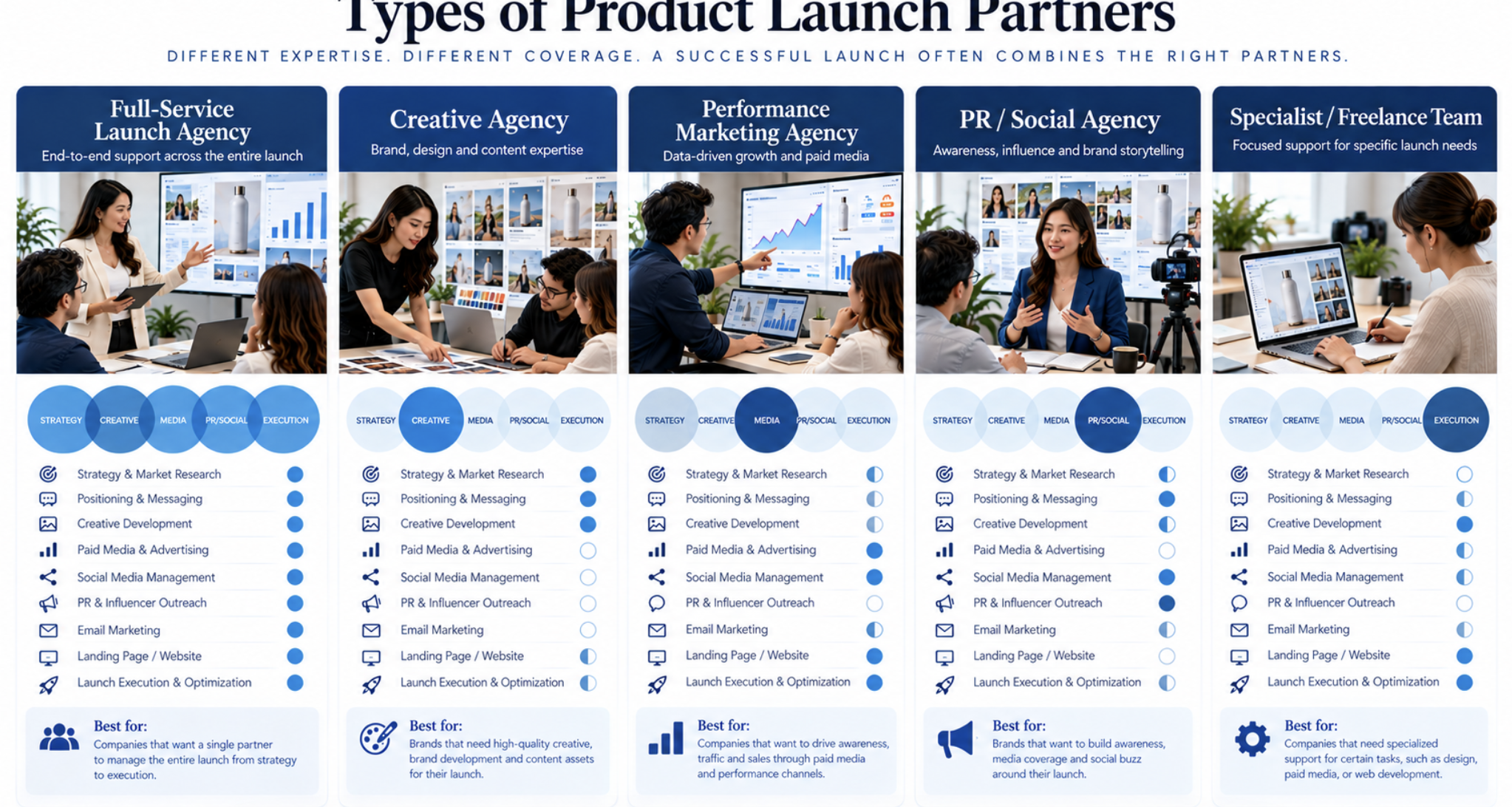
There isn’t a default model for launch support. Start with the workstreams you need a partner to own and what will remain with your team.
Full Launch Agency
A full launch agency coordinates strategy, positioning, creative, production and channel rollout. It fits a multi-channel launch when one partner needs to manage the roadmap and keep specialist teams aligned. Your team still supplies product information, handles approvals and makes internal decisions.
Creative Agency
A creative agency usually leads the campaign concept, messaging, visual direction and asset production. It can work well when your team already has channel strategy, PR and launch operations covered. Compare creative direction agencies if the campaign idea and creative system are your main gaps.
PR-Led Launch
A PR-led launch puts earned media, press materials, outreach and launch announcements at the center. It fits when media coverage is central to the rollout, but the brand may still need separate support for paid media, creative production and channel execution. Compare PR agencies if earned media is the priority.
Performance Partner
A performance partner manages paid distribution, testing and optimization during the launch window. This model fits when the positioning, campaign creative and broader go-to-market plan are already in place. Compare paid social agencies when paid social is a priority channel.
Choose based on the work the partner needs to own, not the agency label. If you’re still weighing broader options, compare types of marketing agencies by their typical scope.
How to Choose a Launch Agency
Choosing a launch partner is different from choosing a general marketing agency. You aren’t only evaluating ideas or credentials.
You’re evaluating whether the team can keep strategy, creative and execution aligned around a launch date that cannot move.
Look for Launch Experience, Not Just Industry Experience
Industry familiarity can help, but the stronger signal is experience with the type of launch you’re planning. Ask the agency to walk through a launch it managed from planning through execution: what it owned, which dependencies mattered and where the plan changed.
Compare the complexity of the work, not just the familiarity of the client logo. Listen for specifics about approvals, production, channel coordination and launch-week decisions.
An agency that knows your industry but has only delivered isolated campaigns may not have the launch experience your project requires.
Ask Whether They’ve Worked Toward a Fixed External Date
Retail windows, product availability, partner commitments and press timing can create deadlines that don’t move easily. Ask for a specific example of how the agency worked backward from a fixed date, set milestones and built time for approvals and production.
Then ask what happened when a dependency slipped. A useful answer should explain how the team surfaced the risk, decided what could change and protected launch-critical work.
General claims about working quickly aren’t enough. You need to understand how the agency’s process works under pressure.
Find Out Who Will Actually Work on the Launch
The senior people leading the pitch may not be the team managing the account during launch week. Ask for the names and roles of the people responsible for strategy, creative, production and project management.
Clarify who can make decisions, who will be available in the days leading up to launch and how senior oversight works.
A clear team structure matters because launch decisions often happen quickly across several workstreams. Before you sign, know who answers questions, resolves conflicting feedback and keeps the schedule moving.
Understand How Scope Changes Are Handled
Scope changes are normal, but a fixed launch date limits the available options. Ask how the agency documents a change and evaluates its effect on deliverables, timing and cost.
Then confirm who approves additional work and when. Use a realistic scenario, such as a product detail changing after assets enter production or a new deliverable being added close to launch.
Listen for honest tradeoffs. A strong partner should explain what can change, what must stay fixed and how each choice affects the remaining work.
Ask What Happens After Launch
Launch week isn’t always the natural end of the engagement. Ask exactly what the agency will hand over, including final assets, source files if they’re part of the scope, account access, reporting, documentation and recommendations.
Confirm whether post-launch optimization, a results review or continued support is included and for how long. Also clarify who owns the files and which requests would require a new scope.
A clear handoff prevents confusion when your internal team takes over the next phase.
For selection criteria that apply beyond launch work, use how to choose a marketing agency as a broader guide.
When to Hire: Launch Timelines
Bring a launch agency in before production begins, not when the first assets are already due. A 12-16 week runway is a practical starting point for a multi-channel consumer launch. A focused campaign may need less time, while packaging, retail or major production can require more.
Start the agency search before that runway begins so the selection process doesn’t consume the time needed for strategy and execution.
A sample working-back timeline looks like this:
- 12-16 weeks before launch: Select the agency, confirm the scope and budget, assign responsibilities and align on positioning, audiences, channels and critical dependencies.
- 8-12 weeks before launch: Develop the messaging, campaign concept, creative direction and channel plan. Approve the central direction before full production begins.
- 4-8 weeks before launch: Produce photography, video, landing pages, email assets, paid media, social and PR or influencer materials included in the scope.
- 2-4 weeks before launch: Complete revisions, internal or legal approvals, channel setup, asset delivery and final production handoffs.
- Final week: Check links, tracking and final assets, confirm launch-day responsibilities and resolve anything still blocking the rollout.
- Launch day and after: Activate the campaign, monitor delivery across channels and document early feedback and performance data.
Production lead times often determine how early the work needs to begin. If the launch requires product samples, photography, video, packaging or retail assets, the agency needs those inputs early enough to keep later approvals from becoming bottlenecks.
Hiring late doesn’t automatically derail the launch, but it changes the available options. Compressed strategy, production and review time can limit creative exploration, narrow the channel plan and increase the chance of rush costs. When the launch date stays fixed, something else usually has to flex: the scope, budget or number of review rounds.
Use the product launch marketing checklist to map deliverables, owners and deadlines before the agency search begins.
What Does a Launch Agency Cost?
There isn’t a standard price for hiring a launch agency. The fee depends on the scope, production needs, timeline and level of support required. Without a defined scope, a broad price range tells you very little about what the engagement includes.
A project-based fee covers a defined launch window, set of deliverables and agreed timeline. It fits when the work has a clear beginning and handoff.
A retainer covers ongoing support over an agreed period. It can fit when the agency will continue managing creative production, channel execution or optimization after launch day.
The main cost drivers include:
- The amount of research, strategy and positioning work required.
- The number and complexity of creative deliverables.
- Production needs such as photography, video or animation.
- The number of channels and specialist teams involved.
- The timeline, revision process and post-launch support.
Media spend is separate from the agency fee unless the proposal explicitly combines them. Third-party production costs may also be quoted separately.
Compare proposals line by line, not by the headline price alone. Confirm what the fee includes, which costs are separate, how many revision rounds are covered and what happens when the scope changes.
Brands using Breef receive expert support and curated pitches, then pay a one-time $199 placement fee when they hire an agency. Agency fees are separate. See what Breef costs for details, or review agency pricing models for a deeper comparison of project-based, retainer and hourly structures.
What You Supply vs. What the Agency Owns
The brand supplies the inputs, access and approvals only it can provide. The agency owns the launch work defined in the scope. Agree on that split before production begins because a delayed input or approval can affect the work that follows.
What the Brand Supplies
- Confirmed product details, availability and launch date
- Product samples or prototypes needed for creative production
- Brand guidelines, existing assets and relevant past work
- Internal stakeholder and legal approvals
- Retail or platform requirements, access and deadlines
What the Agency Owns
- The launch roadmap, milestones and dependencies
- The strategy, messaging and creative direction included in the scope
- Production and delivery of the agreed assets
- Coordination among the specialist teams it manages
- Channel setup and launch-week support when included in the engagement
Use a project scope to define deliverables, responsibilities, dates and the process for changes. Then use an agency brief template to provide the product context, goals and constraints the agency needs to begin.
Clear ownership keeps late inputs and unanswered decisions from becoming launch-week problems.
Find the Right Launch and GTM Agencies With Breef
Your launch has a date. Your agency search shouldn’t slow it down.
Breef helps brands find launch and go-to-market partners from a community of 25K+ vetted agencies. Team Breef curates agencies based on your project scope, goals and timeline so you can compare pitches and choose the right agency with confidence.
Explore launch and GTM agencies or start your project with Breef.
Frequently Asked Questions
What Is a Go-to-Market Agency?
A go-to-market agency helps a brand plan and execute how a product reaches customers. For consumer launches, that can include positioning, messaging, creative, campaigns, channel execution and launch coordination. In B2B, the same term often refers to outbound sales, SDR programs and pipeline development, so confirm the agency’s scope.
How Much Does a Product Launch Agency Cost?
Product launch agency costs depend on the scope, production needs, timeline and level of support. A project-based fee can cover a defined launch, while a retainer can cover ongoing work. Treat media spend and third-party costs as separate unless the proposal explicitly includes them.
How Far in Advance Should I Hire for a Launch?
For a multi-channel consumer launch, 12-16 weeks is a practical starting point. Packaging, retail or major production may require more time. Begin the agency search before that runway starts so selection doesn’t take time away from strategy, production and approvals.
Do I Need a Launch Agency or Can My Current Agency Handle It?
Your current agency can handle the launch if it has relevant launch experience, enough capacity and a clear process for working toward fixed dates. If it lacks a key capability or can’t coordinate the full scope, add a specialist partner or consider a full launch agency.
What Is the Difference Between a Launch Agency and a PR Agency?
A launch agency coordinates a broader product launch across positioning, creative, production and channel execution. A PR agency focuses on communications, media outreach and earned coverage. Depending on the goals and scope, a brand may hire either type of partner or work with both.