Why Scarcity Marketing Feels Bigger Than Ever
Scarcity marketing has always existed in some capacity — what’s new is how common it’s becoming. Whether it's a limited-edition launch or an exclusive waitlist, the principle is simple: people tend to value what feels difficult to obtain. But as scarcity marketing becomes increasingly common across industries, consumer reactions are becoming more divided. What once felt exciting and exclusive can now feel expected, and in some cases, exhausting.

Scarcity marketing is everywhere, even though most brands deploying it would never call it that.
Limited drops, waitlist launches, low-stock alerts: the mechanics have become so normalized that consumers barely clock them as tactics anymore. The interesting part isn't the strategy itself, but how differently it lands with consumers.
One segment has fully bought in. For these consumers, owning something limited isn't just about the product — it's about timing, status and access. Brands like Parke, SET Active and Ffern have built entire identities around this psychology, where the scarcity is the value proposition. If you miss a drop, you miss your moment.
At the same time, a growing group is reacting in the opposite direction. Rather than being motivated by scarcity, some consumers read the manufactured urgency, anxiety and pressure to buy as manipulation. It's no surprise then that these consumers hit 'Unsubscribe' and move toward brands that reward patience and consideration, not panic. And while some shoppers love the thrill of a limited drop, others would rather not schedule their afternoon around one.
The real question isn't whether scarcity works. In the short term, it absolutely does. But in the long-term, can brands really build loyalty if customers repeatedly miss out on launches? Does exclusivity remain attractive to consumers, or does it eventually create fatigue? And if every brand embraces scarcity, does it lose the very thing that made it effective? If consumers repeatedly miss out — or opt out entirely — brands may find they've optimized for the transaction at the expense of the relationship.

🎧 Audible | Story House
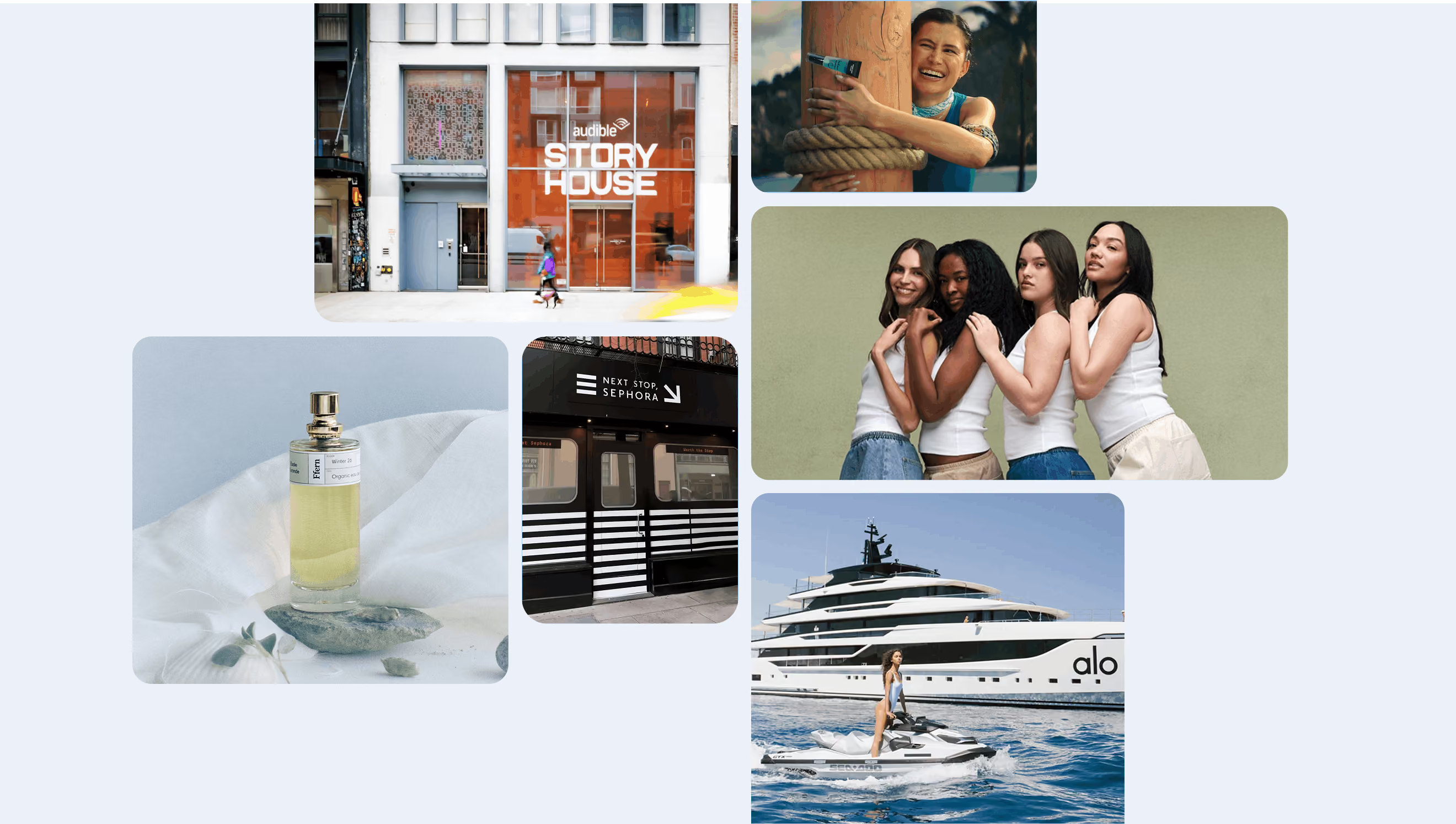
Audible has opened Story House in New York City, a space that reimagines the bookstore for the audiobook era. Visitors can browse audiobooks on shelves, listen through headphones, and spend time in spaces like a café, listening bar and lounge, alongside a calendar of community events. It’s a thoughtful way to give a physical presence to a category that typically exists entirely online.
🏕️ J.Crew | Camp J.Crew
For its latest summer campaign, J.Crew reunited familiar faces from the 2010s modeling era, like Jasmine Tookes and Josephine Skriver, for a nostalgic, camp-themed escape. Between the cast and the setting, the campaign feels like a throwback to a different era of fashion marketing — one that's increasingly resonating again.
🌊 e.l.f | Survivor
Ahead of the Survivor finale, e.l.f. teamed up with comedian and creator Delaney Rowe for a campaign that imagines beauty products as an advantage in one of the show's most iconic challenges. The spot feels tailor-made for fans, pulling directly from the world and mechanics of the show.
🚇 Sephora | Next Stop Sephora
Sephora transformed a New York City pop-up into a subway station-inspired experience centered around men's fragrances. Built around the idea that "the boys are at Sephora," the activation is another indication that men's beauty is moving further into the mainstream — and a sign of how seriously the retailer is taking the category.
🛥️ Alo Yoga | Alo Voyage
Alo and Vogue France brought wellness to the Cannes Film Festival with Alo Voyage, a three-day retreat at sea featuring yoga, Pilates and other wellness experiences aboard a yacht. The activation builds on Alo's growing ecosystem of exclusive experiences, extending the same aspirational world that has made the brand's invite-only Alo Gym a fixture across social media.

📄 Why retailers like Target and Aerie are moving beyond straight affiliate deals with creators (Digiday): As affiliate programs mature, retailers are experimenting with longer-term creator partnerships that go beyond commissions, prioritizing authenticity, stronger storytelling and deeper audience relationships.
📄 What Can the World Cup Tell Us About the Future of Cultural IP? (The Sociology of Business): A fascinating look at why the World Cup remains one of the world's most valuable cultural properties, and what brands can learn from it about participation, identity and building fandom that lasts.
🎧 How Ford is Reengineering Its Iconic Brand Without Losing Its Heritage (Brand New World): Ford CMO Suzy Deering on modernizing one of the world's most recognizable brands, balancing innovation with heritage and bringing in new audiences.
📄 Paid Isn't Dead. But Your Playbooks Need an Upgrade (MKT1): As platforms evolve and performance becomes harder to predict, MKT1 explores how marketers should be adapting their approach to paid growth.
Final Thoughts
Scarcity isn't inherently good or bad — its effectiveness depends on when and how often it’s used. For some consumers, limited availability adds excitement, but for others, it creates friction and a reason to look elsewhere.
As brands continue leaning into exclusivity-driven launches, the challenge won't be generating demand; it will be balancing urgency with accessibility. Because while scarcity can make consumers want something today, loyalty is what keeps them coming back tomorrow.
That wraps this issue of the debreef. Keep an eye on your inbox for the next edition. In the meantime, browse more on our blog: The Breefing Room