
Building your project scope
Hang tight. We’re customizing your scope based on your project needs


10 Marketing
Trends for 2026
We're breaking down the trends and shifts already defining how brands grow, scale and compete in 2026.
January 30, 2026
10 minute read
10 minute read
Marketing in 2026 isn't about doing more. It's about doing things differently.
The playbook that worked three years ago isn’t good enough anymore. Most discovery doesn’t happen on search results pages anymore. Polished content gets scrolled past while authentic voices break through. The agency model itself is being rebuilt around specialization, flexibility and real outcomes.
What’s replacing this outdated model isn’t a single channel or tactic. It’s a shift in how growth is built. Here are 10 trends defining that shift and what they mean for the decisions marketers are making right now.
What’s replacing this outdated model isn’t a single channel or tactic. It’s a shift in how growth is built. Here are 10 trends defining that shift and what they mean for the decisions marketers are making right now.
01
How search is changing in 2026
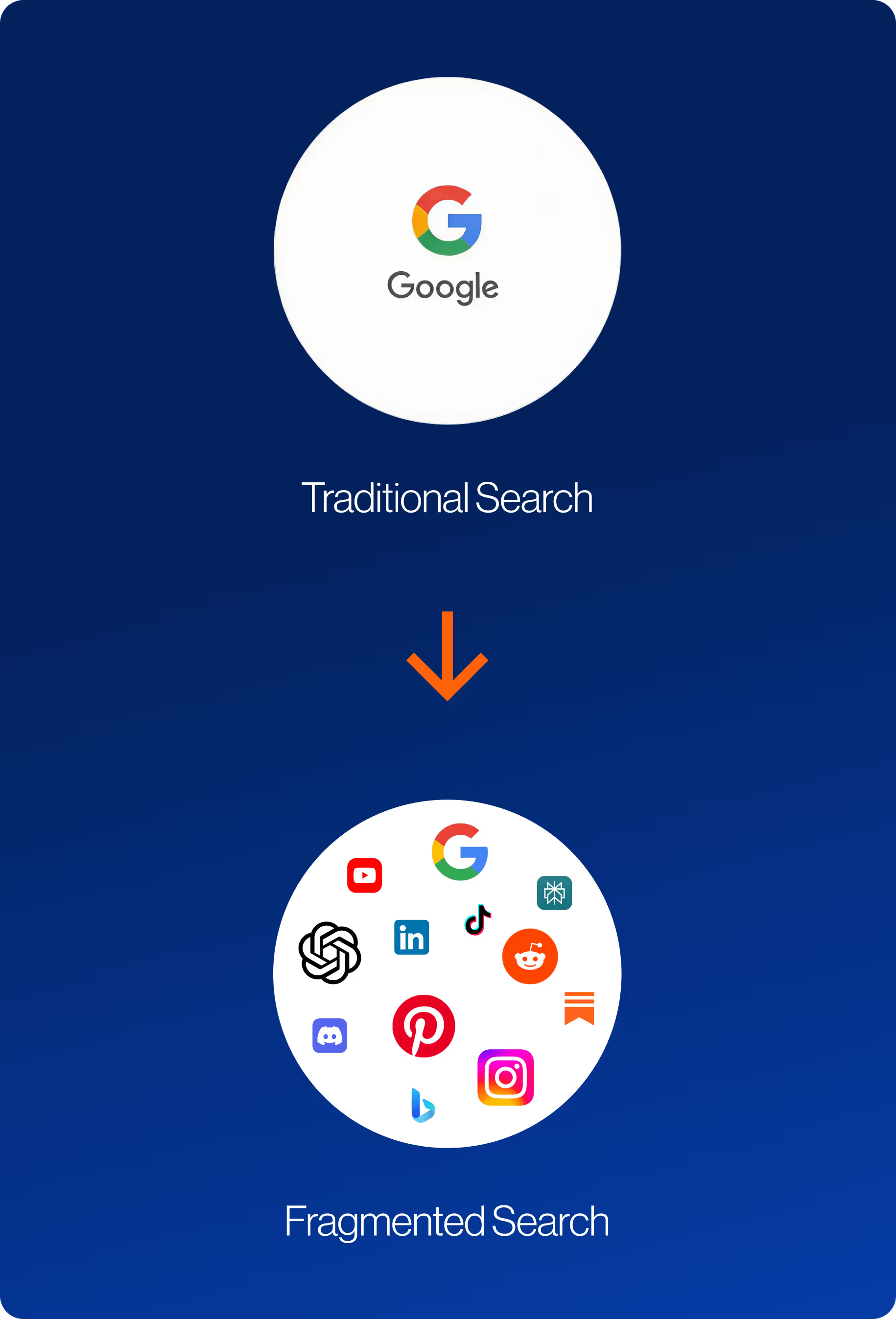
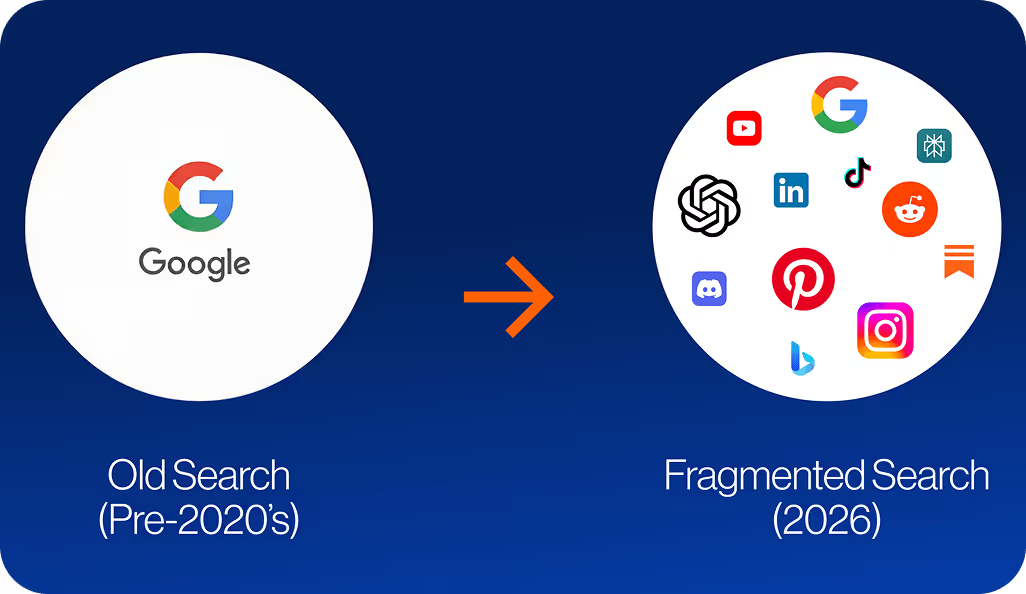
Search is everywhere. That’s the problem.
Search isn't dead, it's everywhere. And that's exactly the problem.
Customers ask AI assistants for recommendations, scroll TikTok for reviews and validate decisions in Reddit threads or private communities. Many never reach a brand’s website or a Google search results page at all.
Discovery now happens across dozens of channels, each with its own formats, rules and trust signals. Brands that still treat search as a single channel are increasingly invisible where decisions actually happen.
Customers ask AI assistants for recommendations, scroll TikTok for reviews and validate decisions in Reddit threads or private communities. Many never reach a brand’s website or a Google search results page at all.
Discovery now happens across dozens of channels, each with its own formats, rules and trust signals. Brands that still treat search as a single channel are increasingly invisible where decisions actually happen.
Why ranking on Google alone is no longer enough
Google still drives traffic, but it's no longer the universal starting point. Recent research from Sprout Social shows that over 40% of Gen Z turn to social platforms first when looking for information. AI assistants like ChatGPT answer questions directly, often without sending traffic anywhere. Marketplaces and platforms like Amazon and YouTube are closed-loop ecosystems where visibility depends entirely on platform-specific optimization.
The shift isn’t just technical, it’s behavioral. People want answers, not links. They want recommendations from trusted voices, not brand copy — even if the trusted voice is a 23-year-old influencer’s Instagram story. Most importantly, consumers want discovery to be easy and native to wherever they already are.
The shift isn’t just technical, it’s behavioral. People want answers, not links. They want recommendations from trusted voices, not brand copy — even if the trusted voice is a 23-year-old influencer’s Instagram story. Most importantly, consumers want discovery to be easy and native to wherever they already are.
How to optimize content for search marketing in 2026
Write for answer engines, not just search engines
Use headers that match searches, make sure your copy contains clear and direct answers, and cite credible and recent sources.
Treat social platforms like search destinations
Optimize for each platform’s algorithm: TikTok videos with engaging hooks, Instagram posts with strong keywords, etc.
Build community credibility over promotional presence
Provide real value and earn trust on community channels like Reddit threads, LinkedIn forums and Slack communities.

02
Why thought leadership is replacing generic content marketing
AI made content production easy and cheap. It also made producing interesting content harder.
Generic advice, surface-level listicles and "best practices" content no longer breaks through because everyone's producing it at scale (well, AI is producing it at scale). Consumers demand content with a clear point of view: original research, hot takes, lived experience and authority.
Generic advice, surface-level listicles and "best practices" content no longer breaks through because everyone's producing it at scale (well, AI is producing it at scale). Consumers demand content with a clear point of view: original research, hot takes, lived experience and authority.
How the bar for “good content” rose overnight
As AI tools became more accessible, content production costs dropped. Brands that published weekly started publishing daily. The volume explosion made attention even scarcer.
The issue isn't AI itself. It's how brands use it. Audiences gravitate toward content that has a pulse, not another rephrased blog article.
The issue isn't AI itself. It's how brands use it. Audiences gravitate toward content that has a pulse, not another rephrased blog article.
What actually qualifies as thought leadership
Content marketing fills calendars. Thought leadership starts conversations.
Instead of "5 ways to improve email open rates," thought leadership argues "Why optimizing for email open rates is killing your customer relationships" and backs it up with data from actual campaigns, specific examples and a framework for thinking differently.
The point of thought leadership is that it can only come from you because it's built on data, experience or insights no one else has.
Instead of "5 ways to improve email open rates," thought leadership argues "Why optimizing for email open rates is killing your customer relationships" and backs it up with data from actual campaigns, specific examples and a framework for thinking differently.
The point of thought leadership is that it can only come from you because it's built on data, experience or insights no one else has.
“If ChatGPT can generate your article in 20 minutes, it’s not thought leadership.”
03
How affiliate and ambassador models are redefining influencer ROI
Influencer marketing is moving away from one-off sponsorships to partnerships where creators have skin in the game.

Why performance-based partnerships are winning
Brands are tired of paying $10,000 for a single post that generates impressions but zero trackable sales. The traditional flat fee, one-time deliverable model that chases “brand awareness” doesn’t work for brands that need to drive sales, justify every dollar and prove marketing ROI.
Affiliate flips the equation. Instead of paying upfront for exposure, brands only pay for results.
The shift benefits everyone. Brands only pay for results, which dramatically improves ROI and makes creator marketing accessible to smaller budgets. Creators who drive real sales earn more than they would from flat fees and build recurring income streams instead of constantly hustling for the next one-off deal. And customers get authentic recommendations from creators they already trust—people who have actual incentive to promote products that perform, not just whoever paid them this month.
Affiliate flips the equation. Instead of paying upfront for exposure, brands only pay for results.
The shift benefits everyone. Brands only pay for results, which dramatically improves ROI and makes creator marketing accessible to smaller budgets. Creators who drive real sales earn more than they would from flat fees and build recurring income streams instead of constantly hustling for the next one-off deal. And customers get authentic recommendations from creators they already trust—people who have actual incentive to promote products that perform, not just whoever paid them this month.
When to invest in affiliate vs. traditional influencer marketing
The most effective creator strategies don't choose one or the other — and the mistake is treating them as interchangeable.
Try affiliate
Limited upfront budget
Customers buy quickly after discovery
Your priority is trackable revenue, not brand lift or big names
Stick to influencer
Prepared to invest a larger upfront budget
Your product is aspirational / not an everyday essential
Brand lift and visibility matter more than direct attribution
04
Why first-party data is the future of marketing
Third-party cookies are gone. iOS tracking is limited. Platform algorithms change without warning. The marketers winning in 2026 are focused onbuilding their own data instead of relying on external signals.

How data privacy and platform changes are reshaping targeting
Cookie deprecation and privacy updates from Apple and Google fundamentally changed targeting and measurement. Old methods of retargeting anonymous website visitors, building lookalike audiences from platform data and relying on pixel tracking for attribution aren’t reliable anymore.
First-party data collected directly from customers enables personalization, prediction and resilience when external signals disappear.
First-party data collected directly from customers enables personalization, prediction and resilience when external signals disappear.
How to collect and leverage first-party data
You don't need a tech stack overhaul to build first-party data. You need touchpoints where customers are engaged and willing to share information.
TOFU website touchpoints: Use onboarding flows or website pop-ups to find out why a customer showed up in the first place. Ask what problem they’re trying to solve or which brands they’ve already tried. That context can power segmentation, personalization and messaging.
Post-purchase surveys: Short email or SMS surveys can support future retention marketing efforts and start conversations with customers. Ask what benefit they’re most excited about or what product they want next.
Ad questionnaires: Platform-native survey tools help you learn about preferences and intent before someone even converts. These signals shape targeting and creative while building momentum with soon-to-be buyers, even before they formally identify themselves.
“Every customer interaction, milestone and session should drive growth.”
05
Why marketing is becoming
more product-led
The best marketing doesn't feel like marketing. It's baked into the product experience and the way customers naturally discover and share the brand.
Product-led growth (PLG) used to belong to SaaS companies with free trials. Now it's expanding across industries as marketers realize campaigns alone don't drive sustainable growth. In 2026, distribution needs to be built in, not added on.
Product-led growth (PLG) used to belong to SaaS companies with free trials. Now it's expanding across industries as marketers realize campaigns alone don't drive sustainable growth. In 2026, distribution needs to be built in, not added on.
Why campaigns alone no longer drive
sustainable growth
Traditional campaign-driven marketing follows a predictable cycle: launch something, drive traffic through paid, convert, repeat when momentum fades. It works, but it's expensive, exhausting and dependent on constant spend.
Instead of relying on paid acquisition for every customer, product-led strategies build growth mechanics into the product.
Instead of relying on paid acquisition for every customer, product-led strategies build growth mechanics into the product.
Where to start with product-led marketing
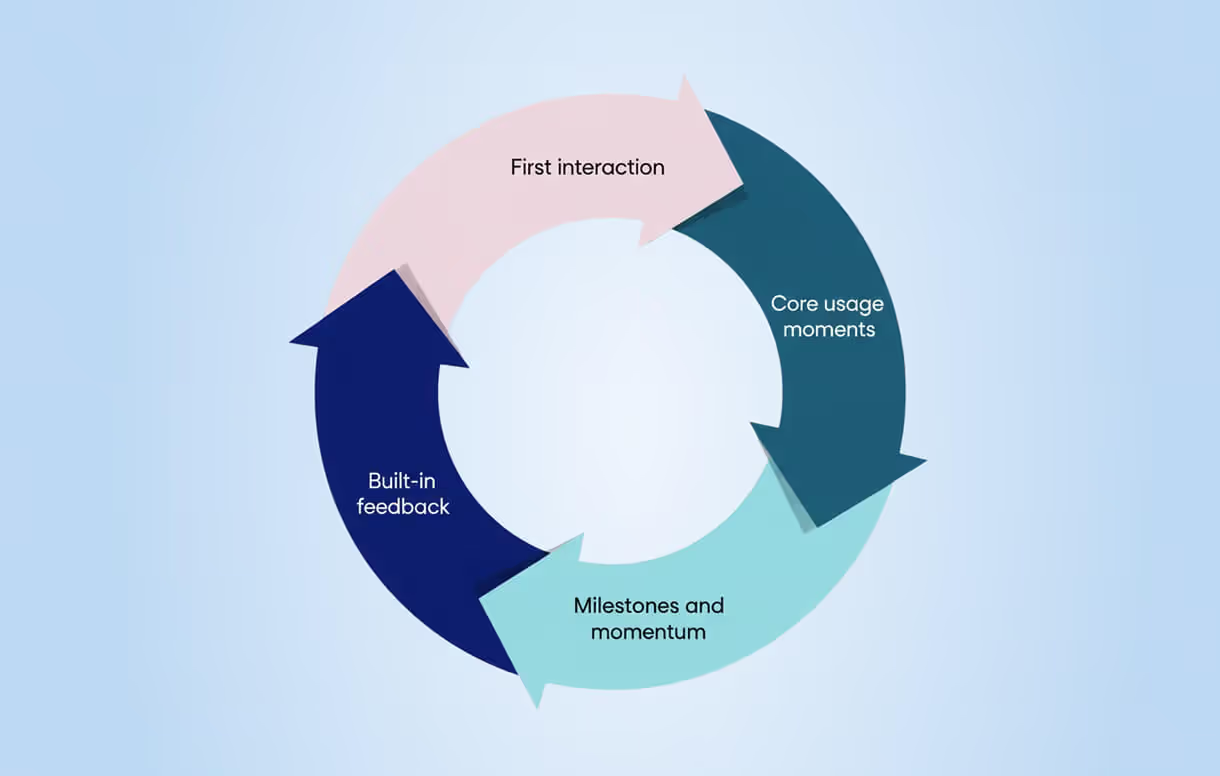
Find moments where the product can do the marketing for you.
First interaction: The first impression sets the tone. When onboarding or purchasing is engaging, customers immediately understand the value.
Core usage moments: Repeat actions, feature adoption or reorders are natural points to reinforce value, introduce what’s next or encourage sharing. These moments feel relevant because they’re triggered by behavior, not timing.
Milestones and momentum: When a customer hits a goal, finishes a flow or restocks, it’s a natural time to suggest an upgrade, referral or complementary product.
Built-in feedback: Close the loop by listening. Lightweight prompts or questions show what’s working and inform what to refine, promote or simplify next. Hello, first-party data!
Product marketing isn’t about adding more messages.It’s about making the product experience so clear and useful that marketing feels like a natural extension of it.

06
Why modular marketing teams are replacing
one-size-fits-all agencies
The full-service agency retainer isn’t the golden ticket to success anymore. Not because agencies aren't valuable,
but because brands need flexibility, specialized expertise and control over spend.
but because brands need flexibility, specialized expertise and control over spend.
Why small teams outperform large retainers
Large agency retainers come with overhead: account managers who coordinate but don't execute, layers of approval that slow decisions and generalists stretched across disciplines they're not experts in. Brands pay for infrastructure whether they need it or not.
Modular teams and boutique agencies let brands work with experts, without paying for unused services. A growth specialist for demand gen, a design studio for creative, a digital agency for retention flows. Every partner is an expert so that every channel drives impact.
Modular teams and boutique agencies let brands work with experts, without paying for unused services. A growth specialist for demand gen, a design studio for creative, a digital agency for retention flows. Every partner is an expert so that every channel drives impact.
How to sequence agency partners strategically
Hiring the wrong partner at the wrong stage wastes budget and can cost twice as much time as the search process did. Sequencing matters just as much as working with the right partner.
We’ve worked with tens of thousands of brands at Breef, from Fortune 500s to day-1 startups. It turns out, there is a right or wrong answer to the “should I hire an agency?” question. While that answer is different for every brand, there are a few stages where marketing teams tend to bring in different types of support.
We’ve worked with tens of thousands of brands at Breef, from Fortune 500s to day-1 startups. It turns out, there is a right or wrong answer to the “should I hire an agency?” question. While that answer is different for every brand, there are a few stages where marketing teams tend to bring in different types of support.
Early Stage
- Branding + messaging
- GTM strategy
- Social + content
Growth + Scale
- Performance marketing
- Email, SMS + retention
- PR or creator
Expansion + Evolution
- Omnichannel campaigns
- Activations + partnerships
- Growth marketing
07
How to use AI for content without sacrificing taste
AI in marketing is a hot topic, but how you incorporate it is what makes the difference. Use AI to accelerate human thinking, not replace it.
How to leverage AI in marketing
Use AI for iteration, not ideation
Let AI generate 20 headline variations, formats or visual styles once you know the core message or creative direction. Don't ask it to come up with your positioning or creative concept from scratch.
Treat AI output as a first draft, not final copy
Every AI-generated piece needs a human editor who understands your brand voice, audience and what will actually resonate. AI can draft content, but humans need to sharpen it with taste and style.
Deploy AI for high-volume, lower-stakes content
Social captions, email subject line tests and product descriptions are ideal AI use cases. Your hero campaigns and thought leadership pieces? Those need human authorship from start to finish.
Prepare a clear brief before touching AI
If you can't articulate what makes something on-brand or "good" by your standards, AI will amplify that lack of clarity. The upfront thinking that you do to brief AI shapes everything that follows.

.avif)
When not to use AI in marketing. Let humans take the lead here:
Creative direction
Conceptual thinking
Brand voice
Strategic decisions
Quality control
08
How employee-led and internal influencer content drives trust and reach
Brand accounts are just polished and distant enough to not feel entirely real. Your employees, on the other hand, sound like actual people. In 2026, people want to hear from people — authenticity is what builds trust and drives reach.

Why employee content outperforms brand content
According to a report by Edelman, messages shared by employees on social media receive 561% more reach than the same content posted by brand accounts.
Employee advocacy (where team members share experiences, expertise and behind-the-scenes moments) is becoming one of the most effective distribution channels. Your employees sound like actual people, and consumers want real voices, real insights and authenticity.
Employee advocacy (where team members share experiences, expertise and behind-the-scenes moments) is becoming one of the most effective distribution channels. Your employees sound like actual people, and consumers want real voices, real insights and authenticity.
How to enable employee advocacy
This dynamic is especially powerful on social channels, where personal brands carry more weight than corporate ones. LinkedIn stands out as the most powerful channel for employee advocacy, with engagement rates significantly higher than other platforms.
Brands that empower teams to show up authentically are reaping benefits in visibility, engagement and trust that ads can't buy. Reward your team for creating content about your brand. Create micro-campaigns that employees can opt in to. Keep it authentic: don’t force scripts or distribution.
Brands that empower teams to show up authentically are reaping benefits in visibility, engagement and trust that ads can't buy. Reward your team for creating content about your brand. Create micro-campaigns that employees can opt in to. Keep it authentic: don’t force scripts or distribution.
“In a world where anyone can claim expertise, trust is the ultimate differentiator.”
09
Why marketing infrastructure matters more than ever
The brands scaling efficiently in 2026 are building better infrastructure in the background. The right tech stack, internal workflows, team structure and foundations can make every asset more effective and every dollar work harder.
Why systems and infrastructure matter more than individual tactics
When your data systems are clean and unified, every tactic, campaign and strategy makes the next one smarter. When content operations are streamlined, you produce more high-quality work without burning out. When your tech stack is integrated, you automate workflows that used to require manual effort.
Individual contributors are great, but they’re only as effective as their systems.
Individual contributors are great, but they’re only as effective as their systems.
What to audit as you scale in 2026
Data infrastructure: Can you answer basic questions like “which channels acquire customers with the greatest LTV?” or “what’s the real ROI of our email program?” If not, then your data isn’t ready to support scale.
Content operations: Are you recreating work because assets live in random folders? Are the only approval guidelines your CMO’s opinion? Strong operations ensure that calendars actually get followed, without the painful 10-step approval process.
Technology integration: In 2026, there’s no excuse for all of your systems to not talk to each other. Your CRM should sync with your email platform and your customer support data should inform segmentation. Make sure your systems aren’t siloed.
10
Why trust signals are a competitive advantage
In a world where AI generates convincing content at scale and anyone can claim expertise, trust has become the ultimate differentiator. Consumers are naturally skeptical, especially in an oversaturated economy and social feed.
Brands need to prove value upfront through transparent sourcing, real proof points, customer outcomes and content that demonstrates true expertise.
Brands need to prove value upfront through transparent sourcing, real proof points, customer outcomes and content that demonstrates true expertise.
How credibility influences AI and consumer decisions
Trust signals don't just matter for human audiences. They also influence whether AI systems cite your content as a reliable source.
AI models prioritize sources with clear methodology, authoritative references and demonstrated expertise.
AI models prioritize sources with clear methodology, authoritative references and demonstrated expertise.
Trust signals determine whether consumers convert or keep shopping around
Case studies, proven client outcomes, transparent marketing and credible content keeps consumers coming back.
Trust is built through quality, clarity, consistency and proof. Make sure that every step of your marketing, sales and retention flows build trust.
Trust is built through quality, clarity, consistency and proof. Make sure that every step of your marketing, sales and retention flows build trust.
How marketers can get ahead in 2026
This all points to the same fundamental shift: growth is a direct product of what you build. You can’t rely on one platform for discovery, fake expertise with AI content or build sustainable growth with a few Instagram assets. You need strategies that span channels, systems that operate themselves and a deep understand of what your consumers actually want.
The best brands aren’t trying to be everywhere for everyone. They’re doing the right things well, investing where leverage exists and building foundations that outlive individual campaigns.
Better marketing in 2026 isn’t about chasing trends. It’s about acknowledging how marketing works and using its new rules to your advantage.
The best brands aren’t trying to be everywhere for everyone. They’re doing the right things well, investing where leverage exists and building foundations that outlive individual campaigns.
Better marketing in 2026 isn’t about chasing trends. It’s about acknowledging how marketing works and using its new rules to your advantage.
Learn more at The Breefing Room



We’re here to help.
Get in touch to learn more about Breef or answer any questions.

Book a call
This is the best way to start your first project or learn more about Breef.

Send us a message
We’ll be in touch within 24 hours.
Read the answers to common questions
See FAQs


Thank you!
We’ll get back to you soon.
Done
Oops! Something went wrong while submitting the form.

Back
Book a call
This is the best way to start your first project or learn more about Breef.
Back
